Kathmandu Education Support (Cc) (trip)


Kathmandu Education Support (Cc)
- Kathmandu Airport, Nepal
- Volunteer Vacations
| from £1,030* per person | 28 Days | Year-round |
| Comfort accommodations | Exertion level: 3 | |
| Operator: People and Places - Responsible Volunteering | 12 people max | |
Loading map, please wait...
Locations visited/nearby
Nepal, Asia
0 testimonials about this trip.
2 testimonials about the provider, People and Places - Responsible Volunteering:
-
Reviewer: Denise
located in
Ross-shire
Scotland
I have nothing but praise for the way that the entire volunteer experience was; from initial contact to writing this report, I have had openness, excellent communication and explanation. Thank you!.....
– Having contacted people and places and submitted a pen portrait of my personal and profession experience – a task that in itself was very rewarding for me – the placement was negotiated in principle. This was completed in a most professional, friendly and positive way by Kate. .. All very exciting things to do and learn about as well as background recommended reading. At this stage the support and additional information I sought from people and places was supplied by return of email and I was able to chat over possible choices with Kate – I found the whole experience most satisfactory and also learnt much from this part of the placement preparation.......
thank you for the superb way in which you run the volunteer programme - a very satisfied customer. Thank you! -
Reviewer: Paul
located in
Port Elizabeth,
Easter Cape
South Africa
Our most recent volunteers, Robin and Jane, have produced an amazing amount thus far. They came to a computer lab that has departmental Cammi software on, that teachers have been using, but after a day or two of observation the recognized that teachers are only using the system to a limited degree in terms of what all it can produce. First step was to work out the software admin system, which they have done, and they have been assisting the teachers coming to the lab, and upgrading the admin of the system making it more relevant in terms of assessments for the teachers of learners abilities. Robin has had a few interesting encounters with the Education Departments Cammi support staff.
They have run a couple of teacher training sessions on excel, and are setting up model lessons on how to effectively use the Cammi programme in a proper way. This will happen next week!
They have standardized all the desktops, so its easier for teachers, and developed worksheets for the students who are in the lab, but cannot access a terminal due to large class sizes.
And Robin has been team teaching in the grade 4 technology class, working on practical tasks that help teach technology!
So their input has been tremendous.
Just so we don’t forget that things never run smoothly, Nomatansanqa Township has been having the water switched off and on over the last 2 weeks. 800 children, no water for hours is not easy to manage. Added to that, getting home to their homestay and not having access to water to bath, is no fun at all. I am pleased to report though that as of middle of this week the water is back on!
They had a wonderful welcoming ceremony this week, with local stakeholders in attendance. Jane was fascinated by the formality of the programme, which seemed forgotten after each speaker as everyone got up to sing some songs.
On their first day, as we arrived at the school, some Grade R children were outside waving SA flags, and carrying little signs that said Welcome Robin and Jane! A real warm welcome.
Thank you people and places for continuing to send such amazing volunteers! Keep up the good work!
Special information
- This is a custom departure, meaning this trip is offered on dates that you arrange privately with the provider. Additionally, you need to form your own private group for this trip. The itinerary and price here is just a sample. Contact the provider for detailed pricing, minimum group size, and scheduling information. For most providers, the larger the group you are traveling with, the lower the per-person cost will be.
Itinerary
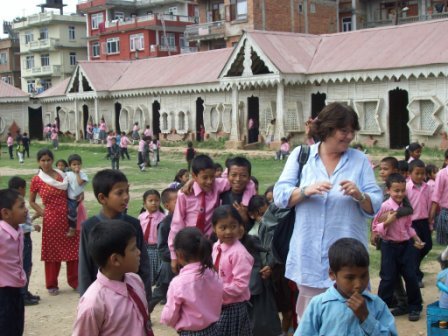
The ProjectFounded and run by Uttam Sanjel, a visionary and philanthropist, this is an enlightened project. Uttam’s goal is to open a school in every one of Nepal’s 75 districts – and he has already founded several, which collectively offer care and education to about 15,000 of Nepal’s children.
Many of the 5,000 children who rely on Samata Schools are listed as Domestic Labour or Factory Labour – left by their parents to be housed with a family while working on household chores or in carpet weaving factories, for example – in return for bed and board. Rural families in particular may need to send children to the city to work because they can’t afford to keep their children at home. Although some 5,000 depend on the schools, there will normally be about 3,000 pupils there at any one time, because many are either at work or on an occasional visit to their home village. Some children are orphans or have been separated from their families during the political upheavals, and for them, Samata is their only home.
Uttam’s priority is to provide a safe and harmonious environment for the children. The schools pay special attention to their cultural and spiritual development, with emphasis on learning about Nepal and its needs, the importance of honesty and harmony, caring for others and living in peace in the world. The schools also encourage children to develop their social and life skills. Many children stress their ambitions to become doctors, nurses, social workers and teachers, wanting to make their own contribution and repay the debt they feel they owe for their education.
Samata provides their only opportunity to gain a School Leaver Certificate (SLC), without which their job prospects are severely curtailed. Many also rely on the schools for a handful of rice at lunchtime and the most basic of medical care.
The schools has been built from scratch and are totally funded by charitable donations, and token fees (of a few pounds a year) from parents who can afford to pay. Uttam improves and adds facilities and buildings whenever funds are available, and recent volunteers have worked with the children to create small garden beds to enhance the surroundings.
The central assembly and play area is unsurfaced ground, surrounded by bamboo and plaster buildings which house the staff room, kitchen, dormitory, library and classrooms – all of which are rudimentary, small and dark. The classrooms have minimal table space for the children and are extremely crowded. One school has computers and it is hoped the other two will have them soon - as and when funds allow.
According to the Nepalese curriculum, lessons should be held in English, although teachers’ own lack of skill and confidence in the language makes this an ideal rather than a reality. Therefore, broader use of the English language in the schools is one of the primary goals of this project – English is the single most important educational tool a Nepalese child can have. Without it, they cannot take public exams and the SLC, or even consider applying for a job in tourism or communications.
English offers some children a passport to a future – language can be taught through basic arts and crafts, creative writing, life-skills and associated conversation, as well as through demonstrating modern teaching methods in classroom lessons.
A long term goal is to enable local staff to gain enough confidence to involve the children in their own learning and replace the current prevalence of 'chalk-and-talk'.
More information from People and Places - Responsible Volunteering:
- View trip on provider's website
www.travel-peopleandplaces.co.uk/ProjectView.aspx?id=144… - Company profile, experience, and history
- View all of their trips
- Email this trip page to a friend
-


Comments from Facebook