Brazil, Argentina & Chile Tour (trip)


Brazil, Argentina & Chile Tour
- Rio Airport, Rio de Janeiro, Brazil
- Active & Adventure
| from $7,990* per person | 20 Days | November |
| Comfort accommodations | Exertion level: 3 | |
| Operator: Adventures Abroad | 12 people max | |
Loading map, please wait...
Locations visited/nearby
Argentina, Brazil, Chile, South America
Itinerary
Day 1 Arrive in Rio de JaneiroToday we arrive in Rio de Janeiro.
Rio is indeed the "Cidade Maravilhosa" (Marvelous City). Seven million Cariocas, as the inhabitants are called, are jammed into one of the world's most beautiful city settings, between ocean and escarpment. This makes Rio one of the most densely populated places on earth. This thick brew of Cariocas pursues pleasure like no other people: beaches and the body beautiful, samba and football, cerveja (beer); and cachaca (sugar-cane rum). In Rio everything ends with samba -- football games, weddings, work, political demonstrations and, of course, a day at the beach. There's a lust for life, and a love of romance, music, dance and talk that seem to distinguish the Cariocas from everyone else.
ATTENTION: This tour is based on a TAME Brazilian Airlines pass that MUST be booked by Adventures Abroad in conjunction with TAME international air tickets. If you intend to secure your own international air, or if you request a routing on an airline other than TAME, a SURCHARGE (approx 500 USD) will apply.
Overnight in Rio de Janeiro. Meal plan: Dinner, if required.
Day 2 Rio de Janeiro: City Tour
Today we have a tour of Rio. The city is divided into a zona norte (north zone) and a zona sul (south zone) by the Serra da Carioca, steep mountains that are part of the Parque Nacional da Tijuca. These mountains descend to the edge of the city centre, where the zonas norte and sul meet. Corcovado, one of these mountain peaks, offers the best way to become familiar with the city's geography -- from it you have views of both zones. The statue Cristo Redentor (Christ the Redeemer), with his outstretched arms, gazes down on the Bahia da Guanabara and the landmark Pao de Acucar (Sugar Loaf). His left arm points toward the zona norte, and his right toward the zona sul suburbs of Copacabana, Ipanema, Leblon and beyond.
We enjoy a sightseeing ride along Rio's beaches -- Leblon, Ipanema and Copacabana. One of the world's most famous beaches runs 4.5 km (3 miles) in front of one of the world's most densely populated residential areas. There is always something happening on the beach during the day and along the footpaths at night: drinking, singing, eating and all kinds of people checking out the scene; tourists watching Brazilians.
From the scalloped beach you can see the granite slabs that surround the entrance to the bay -- a magnificent meeting of land and sea. Different parts of the beach attract different crowds.
We take cable cars to the top of Sugar Loaf Mountain. From the top of this celebrated peak, the city, Baia de Guanabara, and the winding coastline are stretched out dazzling below. To reach the summit at a lofty 400 m (1,325 feet) it is necessary to take two cable cars. A clear day will supply the most spectacular of views: the uncurling arch of the Praia de Copacabana, its miles of tiles glistening in the sun's last rays. From the top you'll see Corcovado Mountain, with the massive statue of Cristo Redemtor (Christ the Redeemer), his arms extended in mercy and blessing.
Overnight in Rio de Janeiro. Meal plan: Breakfast and dinner.
Day 3 Rio de Janeiro - Sao Joao del Rei - Tiradentes
Today we drive to the region of Minas Gerais. Minas Gerais presents a welcome contrast to the rest of Brazil. While the name means "General Mines", the state is packed with exquisite colonial towns, seemingly frozen in another epoch. Their baroque churches and sacred art, mostly sculptures from one of the world's great artists, Aleijadinho, represent over half of Brazil's national monuments.
Nestled in the Sierra do Espinhaco mountain range are the 'cidades historicas', historic colonial cities that grew up with the great gold boom. The foothills and streams of these mountains were scoured for gold throughout the 18th century. Minas also has several hydromineral spa towns in the mountainous southwest corner and a number of prehistoric caves close to the capital, Belo Horizonte.
This afternoon we arrive in Sao Joao del Rei. This city is the only colonial city to have adjusted successfully to life after the gold rush. It has all the usual charm of the other historic cities -- gilded churches, museums, colonial mansions -- but it also has a thriving market town. Easily the largest of the colonial cities with a population of over 80,000, Sao Joao del Rei's modern prosperity complements the colonial atmosphere rather than compromises it. With its wide central boulevard enclosing a small stream, its stone bridges, squares and streets, Sao Joao del Rei is a very attractive place. After an informal visit, we will travel the short distance to Tiradentes.
Tiradentes is small and lovely Gold Rush town is set against a backdrop of the Sao Jose Mountains at an altitude of 930 metres (3,050 feet). Enjoy exploring its cobbled streets on foot, including visits to the Church of Saint Anthony, the town's patron saint, and the Museum of Padre Toledo, housed in an 18th century mansion.
Overnight in Tiradentes. Meal plan: Breakfast and dinner.
Day 4 Tiradentes - Ouro Preto
Today we drive to Ouro Preto. Today's drive is spectacular, with roads winding around hill country, passing several valleys where patches of forest survive. We arrive in Ouro Preto -- a relatively small town which was once the Portuguese base during a war between the Portuguese and the Paulista bandeirantes. Later the town became the capital of the gold-producing area of Minas, and today it is rich with 18th century churches.
The balance of today is spent exploring this colonial town.
Overnight in Ouro Preto. Meal plan: Breakfast and dinner.
Day 5 Ouro Preto - Iguacu Falls
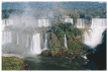
Today we fly to Iguacu Falls. The Iguacu Falls are formed by the Rio Iguacu, which has its source near Curitiba. Starting at an altitude of 1300 m (4,264 feet), the river snakes westward, picking up tributaries and increasing in size and power during its 1200 km (745 mile) journey. About 15 km (9 miles) before joining the Rio Parana, the Iguacu broadens out, then plunges precipitously over an 80 m (263 foot) high cliff, the central of the 275 interlinking cataracts that extend nearly 3 km (2 miles) across the river.
On arrival, before checking in to our hotel (so have your day pack ready!), we view the wonderful Iguacu Falls. We'll only need about half a day here; the view is magnificent and from here you get the clearest idea as to the size of the falls, the area from which to view them is fairly limited. From spots all along the path there are excellent views, at first across the lower river at a point where it has narrowed to channel width. At the bottom of the path, where the river widens again, there's a catwalk leading out towards the falls themselves. Depending on the force of the river, the spray can be quite heavy so, if you have a camera, be sure to carry a plastic bag.
Overnight at Iguacu Falls. Meal plan: Breakfast and dinner.
Day 6 Igua?u Falls, Brazil - Iguazu Falls, Argentina
This morning we travel into Argentina where we have a different view of the falls -- spelled "Iguazu" in Spanish.
On the frontier with Brazil there is a gully -- La Garganta del Diablo (The Devil's Throat) which is 150 metres (492 feet) wide and 700 metres (2,296 feet) long. We wander the paths and bridges along the upper and lower parts of the falls and the paths which go along the river from the observation point of the Bosetti falls to the quay. The plunging falls throw a fine drizzle up to 30 metres (98 feet) into the air, weaving countless rainbows in the sun. Be sure to bring rain-proof clothing.
Overnight Iguazu Falls. Hotel International or similar. Meal plan: Breakfast and dinner.
Day 7 Iguazu Falls - Buenos Aires
You have a half-day free to revisit the paths along the upper and lower parts of the falls (optional 15 pesos per person, local bus 3 pesos) and the path that goes along the river from the observation point of the Bosetti Falls to the quay. The plunging falls throw a fine drizzle up to 30 m (98 feet) into the air, weaving countless rainbows in the sun. Be sure to take rain-proof clothing. The United Nations has declared Iguazu Falls a protected area of worldwide importance.
You can also take an optional boat ride to the base of the falls (100 pesos / 35 USD per person), or the local bus to Iguazu Town where you can explore and observe where Argentine, Brazil, and Uruguay come together. You will need to be back in the hotel this afternoon to be ready for your transfer to the airport; please verify the check-out time from your hotel reception desk.
Later this afternoon we fly to Buenos Aires and transfer to our hotel.
Overnight in Buenos Aires. Meal plan: Breakfast and dinner.
Day 8 Buenos Aires: City Tour
Today we see the sights of this cosmopolitan city. In the early part of the 20th century, Argentina was one of the richest countries in the world. The grand public buildings of Buenos Aires reflect this opulent era. The city is known as the "Paris of South America" because of its wide boulevards and European-style architecture. Buenos Aires was founded for the second time in 1580 by Juan de Garay, just north of Mendoza's encampment. In accordance with Spanish law, he laid out the large Plaza del Fuerte (Fortress Plaza). It acquired its present name of Plaza de Mayo after the month of revolution in 1810. Our tour focuses on the major public buildings.
Catedral Metropolitana, built on the sight of the original colonial church was not completed until 1827. Not only is it considered a major religious landmark, but also a historic site of great importance. Here lies the tomb of Jose de San Martin, the man who (along with Simon Bolivar) liberated South America from Spanish rule in the early 1800's. The Plaza de Mayo is also home to Museo del Cabildo, the Presidential Palace (Casa Rosada), and the National Congress (Palacio del Congreso).
We also visit the Recoleta Cemetery where Buenos Aires' richest citizens are buried in magnificent marble tombs elaborately decorated with statues. The most internationally-famous person buried here is "Evita" Peron. Later this afternoon you may choose to visit in the artists' quarter of San Telmo.
Ask your Tour Leader about the possibility of seeing an optional Tango Show this evening.
Overnight in Buenos Aires. Meal plan: Breakfast and dinner.
Day 9 Buenos Aires: City Tour
Today we have a half-day WALKING tour.
Our first stop is the Centro Naval, one of the city's most exquisite buildings and a masterpiece of cast stone architecture. The building was opened in 1914 and was designed by Swiss architect Jacques Dunant. It's not generally open to the public, but sometimes they let you into the circular lobby.
The Kavanagh Building, at the time of its construction in 1936, was the tallest building in South America, standing at about 120 m (400 ft.) with over 30 stories. Designed as a residential structure, it took more than 16 years to sell the apartments in this Art Deco building. Now it is only the third-tallest building in the city.
Palacio Paz is perhaps the most beautiful of the Beaux Arts mansions in Buenos Aires; the Circulo Militar looks plucked from the Loire Valley. It was the home of the Paz family and took almost 12 years to build; the patriarch who commissioned it died waiting.
The General Jose de San Martin Monument celebrates General Jose de San Martin, who battled against Spain in the wars of independence and is known as the founder of the Argentine nation. The Palacio San Martin is another of the grand mansions that line Plaza San Martin, this was the home of the powerful Anchorenas family whose prestige dated to colonial times in Argentina. The Islas Malvinas-Falkland Islands Memorial honors the more than 700 Argentines who died in the war over the Islas Malvinas/Falkland Islands chain in the brief war with Great Britain in early 1982.
The Torre Monumental (British Clock Tower) is a 1916 gift from the British community in Buenos Aires, along with all other things British, was renamed in response to the Islas Malvinas/Falkland Islands War and is called the Argentine Big Ben by some. Decorated with British royal imperial symbols, the base was partly destroyed by an angry mob during an Islas Malvinas-Falkland Islands memorial service. Inside the tower you'll find a small Buenos Aires City Tourism Information Office, as well as an elevator that you can ride to the top for an excellent view of the city. The tower was placed here to celebrate the completion of the nearby Retiro station, built with British technology.
Retiro Station was opened in 1915 and was built with British technological assistance. Four British architects designed it, and the steel structure was made in Liverpool, England, and shipped to Argentina to be assembled. Our tour ends in the Galerias Pacifico in time for your lunch break. This is the most famous shopping mall in Buenos Aires, opened in 1891. The building was designed to recall the Galleria Vittorio Emanuele II in Milan, with its long halls, glass cupola, and several tiers of shops.
Overnight in Buenos Aires. Meal plan: Breakfast and dinner.
Day 10 Buenos Aires - Bariloche & the "Small Circuit"
A direct flight from Buenos Aires brings us to Bariloche, located in the heart of the Lake District. The Nahuel Huapi National Park extends over 750,000 hectares, of which 330,000 is a National Reserve. Situated in the southwest of Neuquen Province and northwest of Rio Negro, it stretches from the Patagonian steppes to the high Andes. On account of abundant rainfall and summer melt from snowfields and glaciers, there is a great number of lakes and also rivers that flow either to the Atlantic or the Pacific oceans. Lake Nahuel Huapi, covering an area of 60,000 hectares, is the largest in the area.
This afternoon we have the classic half-day tour of the Bariloche region. We will get a general overview of the surrounding area along a 60 Km (40 mi) partial loop excursion, all on a paved road. Our outing heads westward from Bariloche on the highway to Llao Llao along the southern shore of Lake Nahuel Huapi. At Km 8, the road passes Playa Bonita, a small harbour and popular beach. Cerro Campanario, the Belltower Hill, is at Km 18 (mile 12), where our bus may stop on the outward leg or when returning. The view from the top of this hill, reached after a seven minute chairlift ride, is the highlight of the trip. The Catedral Ski Village, at the base of the ski slopes, and part of the city of Bariloche, are visible from this spectacular 360 degree look-out.
The tour continues toward St Eduard's chapel and the Llao Llao Hotel. It is after passing the hotel's golf course, at the 100 inch yearly rainfall boundary, that the Valdivian Rain Forest begins. This is a temperate rain forest, with vines canes and lush vegetation. Our tour continues through a thick beech forest surrounding the western Moreno Lake passing by the base of Lopez Mountain, a sheer 3650 m (12,000 ft) face of rock.
We'll have a short stop further along the road for a breathtaking view high above Moreno Lake, the Puerto Panuelo Harbour, Victoria Island and smaller islands on the lake. On the return trip, the road crosses the bridge between the Moreno lakes and then joins the main road back to Bariloche.
Overnight in the Bariloche area. Meal plan: Breakfast and dinner.
Day 11 Bariloche Area
Today we visit the Francisco P. Moreno Patagonian Museum, inaugurated by National Parks in 1940. It is named after the famous explorer of the Andes and the Patagonian rivers, who donated the lands that were later transformed by the government into the first national park in Argentina. It has halls specializing in natural science, ethnography, pre-history and local and regional history. It also has a library and a bookstore.
We also visit Cerro Viejo Eco-tourist Park, a 10 minute walk friom Bariloche. Here we take a ski lift to a lookout point and descend via a mountain path, where there is flora interpretation, up to an Arrayanes woodland. Finally, at an old wooden barrack where one of the first ski factories in Bariloche used to operate, we can visit the Mountaineer Museum.
Bariloche has a very strong Central European influence; most of the first settlers were of Swiss, German, or Northern Italian origin. These people gave the city its European style, with Swiss chalets, ceramics, chocolates, and neat shop windows. However something tells you that you are not in Europe; boats are seldom seen in the huge Nahuel Huapi Lake, the roads are swallowed up in the wilderness as soon as they leave the city and at night, there are no lights on the opposite shore of the lake.
You will have time to explore the lakeside and to visit Bariloche town with it's chocolate shops and excellent visitors' centre.
Overnight in Bariloche. Meal plan: Breakfast and dinner.
Day 12 Bariloche, Argentina - Lake Crossing - Puerto Varas, Chile
The Andean Lakes Crossing is the most scenic way to travel from Argentina to Chile. This spectacular crossing of the Andes takes us through lakes and mountain passes from Bariloche
to Puerto Varas, and occurs in a very well-orchestrated combination of boat and bus. Our luggage is handled for us -- you just sit back and enjoy the scenery.
After breakfast we leave by bus to Puerto Panuelo, where we will board the ship to navigate to the Puerto Blest Port, where we will arrive at 11:30. From there we will travel by bus to the Puerto Alegre Port at 13:30, visiting the Cascada de los Cantaros Waterfall, and where we will embark to navigate further. We then board a bus that will take us across the border to Chile at an altitude of only 976 m (3,200 ft); we continue on to Peula from which we embark towards Petrohue, sailing on the Lago Todos los Santos. Weather-permitting, we will have views of the Osorno Volcano, and the mountains, Puntiagudo and Tronador. Imposing views of the volcano Volcan Osorno y Calbuco dominate the landscape. At the Parque Nacional Vicente Perez Rosales, we will visit the Saltos del Petrohue Falls, capriciously-shaped volcanic rocks, bathed by emerald water falls.
At 19:30 we arrive in Puerto Varas, the City of Flowers.
Overnight in Puerto Varas. Meal plan: Breakfast and dinner.
Day 13 Puerto Varas - Punta Arenas - Torres del Paine
Early this morning we fly to Punta Arenas and continue by road to Torres del Paine National Park.
The Torres del Paine (Towers of Paine) are spectacular granite pillars which soar almost
vertically more than 2000 m (6,000 feet) above the Patagonian landscape. The park in which the high peaks sit may be considered the finest national park in all of South America. With turquoise lakes, roaring waterfalls, rivers and creeks, dense forests and sprawling glaciers, this is an unequalled destination.
Overnight at Torres del Paine. Meal plan: Breakfast and dinner.
Day 14 Torres del Paine National Park
Today we spend the entire day at Torres del Paine National Park.
Some say Paine was an early settler. Others say the name comes from an ancient Indian word meaning blue -- hearkening to the intense blue of the area's lakes. Whatever the name comes from or means, this is a spectacular park, comparable to Yellowstone or Yosemite in the US. Founded in 1959, Torres del Paine takes in 180,000 ha (450,000 acres). In 1978 UNESCO gave the park World Heritage status, recognizing it as a biosphere especially worthy of
international recognition.
The park is part of the Paine Massif, which lies inside the continent from, or east of, the high central Andean spine. The massif are medium high mountains emerging suddenly from the plains of the Patagonian steppes. The mountains are granite, capped by crumbly sedimentary rock that used to lie on the valley floor. Before the park was acquired by the Chilean government, it belonged to ranchers who overgrazed and also burned down forests to increase pasture area.
The park is still recovering from this devastation, and will be for a while, but it's a chance to see what nature will do, if given a chance. Natural recovery can also be seen, though the glaciers of the park are in quick retreat -- up to 17 m (56 ft) a year for the last 90 years, creating a fascinating study of plant succession and soil build-up from bare rock to forest. The flora of the park ranges from grassland to southern beech forests. Many parts of the park were too remote
for the cattle ranchers, and exist today in a pristine state.
The animal stars of the park are the guanacos and the rheas. Rheas are an ostrich-like bird; guanacos are wild South American cameloids, related to the domesticated llama and alpaca. Native peoples hunted both across the plains, using every part for food and sheltering hide and feathers. When the Europeans came, the guanaco were slaughtered to make way for cattle, and almost became extinct.
We will travel through the park in our coach stopping at various points of interest and scenic viewpoints. We will also have an opportunity to walk one of the many easy-going trails that afford expansive views of the mountains and glaciers for which Patagonia is famous.
Overnight at Torres del Paine. Meal plan: Breakfast and lunch.
Day 15 Torres del Paine, Chile - Calafate, Argentina
Today we travel by road to El Calafate, a resort town on Lake Argentino situated at the entrance to Los Glaciares National Park.
Overnight in Calafate. Meal plan: Breakfast and dinner.
Day 16 Calafate: Perito Moreno Glacier
We leave the shores of Lake Argentino, travel across the lowlands and begin ascending to the sub-Antarctic forest which marks the gateway to Parque Nacional Los Glaciares. Its centre-piece is the Perito Moreno Glacier which, because of unusually favourable local conditions, is one of the world's few advancing glaciers. Huge icebergs on the glacier's 60 m (180 foot) high face calve and collapse into the Canal de los Tempanos as it advances about 100 m (300 feet) a year. The roar of the gigantic ice wall as it crashes into the surrounding channel is an unforgettable experience.
NOTE: Though weather may seem fine in Calafate, the weather near the glacier can be completely different. Generally the nose of Perito Moreno is characterized by cold wind and highly changeable conditions. You should be prepared with layered clothing and a warm hat.
This afternoon we return to Calafate.
Overnight in Calafate. Meal plan: Breakfast and dinner.
Day 17 Calafate: Upsala Glacier
This morning, we depart early from our Calafate hotel to drive the short distance to the boat dock at Puerto Bandera at the western end of Lago Argentino. Here, we board our boat for a picturesque trip across the pristine, exquisite turquoise waters to the Upsala Glacier. The boat lingers in front of the vast wall of ice that is the front of this massive glacier. There are several outside decks that offer excellent views. Cold weather clothing is suitable today.
We return to Calafate late in the afternoon.
Overnight in Calafate. Meal plan: Breakfast and lunch.
Day 18 Calafate - Ushuaia & Tierra del Fuego National Park
Today we fly to Ushuaia on the island of Tierra del Fuego.
Ushuaia is considered the world's southernmost city. In 1520, Magellan passed through the strait that now bears his name, in search of a sea route to the spice islands of Asia. The Yahgan Indians built the fires that inspired Europeans to give this region its name -- "The Land of Fire". At first, very little attention was paid to this rocky and glacial shoreline, and its indigenous Indian population. It was not until the demise of Spain's colonial domination of the region in the late 1800's, that other Europeans began settling here. Ushuaia lies on the north shore of the Beagle Channel, at the very heart of the archipelago, and just east of the Parque Nacional Tierra del Fuego. Since 1950, the town has played host to an important naval base, supporting Argentine claims in Antarctica.
Ushuaia has one of the world's most dramatic settings: surrounding jagged glacial peaks rise from sea level to nearly 1500 m (4,500 ft). In 1870, the South American Missionary Society, a British-based organisation, made Ushuaia its first permanent outpost in the Fuego region.
This afternoon will be spent in the Tierra del Fuego National Park. Just a short drive from town, this pristine nature reserve is home to hundreds of species of birds, in addition to bountiful varieties of plant life. At Lapatoia Bay we reach the southern end of the Pan-American Highway, which starts in Alaska and runs all the way down through Canada, the USA, Central and South America. We will also enjoy a tour of the town, beginning with a visit to the town's museum. Filled with interesting artifacts, the museum catalogues the history of this rugged territory. In Ushuaia we are so far south that it is broad daylight until well after 10 pm.
Overnight in Ushuaia. Meal plan: Breakfast and dinner.
Day 19 Ushuaia: Beagle Channel Cruise - Buenos Aires
Today, weather permitting, we include a cruise on the Beagle Channel, named after the ship on which Darwin sailed through here in 1832. The island of Tierra del Fuego is divided between Argentina and Chile and the Beagle Channel forms part of the border between the two countries. In addition to spectacular scenery, we should see many species of marine mammals and birds.
Please note: As Tierra del Fuego is so close to the Antarctic Circle and surrounded by water, the weather here is extremely changeable hour by hour. In order to maximise our sightseeing, we may have to alter the sequence of our activities. Your Tour Leader will do his/her best to ensure that you see all the items listed on these days but, in the event of extreme weather, other activities may have to be substituted.
Later this afternoon we fly back to Buenos Aires.
(Breakfast and lunch OR dinner at your Tour Leader's discretion).
Overnight in Buenos Aires. Meal plan: Breakfast and dinner.
Day 20 Departure
Departure from Buenos Aires.
BUEN VIAJE! Meal plan: Breakfast.
More information from Adventures Abroad:
- View trip on provider's website
www.adventures-abroad.com/tour/brazil-argentina-and-chile/br3… - Company profile, experience, and history
- View all of their trips
- Email this trip page to a friend
-


Comments from Facebook