Panama Sampler: Birding, Nature &… (trip)


Panama Sampler: Birding, Nature & History
- Tocumen International Airport, Panama
- Active & Adventure
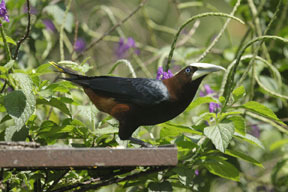
| from $3,390* per person | 9 Days | January |
| Comfort accommodations | Exertion level: 3 | |
| Operator: Naturalist Journeys | 12 people max | |
Join us to explore varied habitats as we search for Panama’s legendary birds and mammals. We move only once, spending 4 nights at each of our lodges. This year we add some options for hiking and kayaking, and a canopy zipline, in addition to birding, natural history and learning history of the Panama Canal.
Our first lodge, the Canopy Tower, is one of the most innovative eco-lodges we’ve found in all our travels. It was once a radar station when the US managed the Canal Zone. Hidden in dense forest, we have nature right out the windows – nothing like watching a sloth feed on flowers while you’re taking a shower! The lodge has private rooms, a spacious common area with dining, a library, and computers, with large windows giving views to the forest all around. A quick climb through a hatch places you atop the forest on an observation deck with views of Panama City’s skyscrapers in the distance, ships passing through the Canal, and birds and monkeys at close range. Trails leading from the Tower give us a chance to spend time seeking out Howler Monkeys, Agoutis, Coatimundis and an array of beautifully colored birds including trogons, toucans, puffbirds, aracaris, parrots, manakins, motmots and more. On field trips from the Tower, we see two of the three locks of the Panama Canal, ride the historic Panama Railroad, and have options for hiking and kayaking on the quiet Chagras River as options in addition to birding.
Our second stay, at the Canopy Lodge, is up in the mountains, where the cool climate and rural charm of country life complements our nature experience. Beautiful Canopy Lodge is surrounded by nature and we dine alfresco with tremendous views of mountains and bustling bird feeders nearby. Along with excellent field time we visit local markets and you can find adventure on the Canopy Adenture’s zipline. Hiking options are close at hand. While in Panama City, we will also visit Panama Viejo, the old part of the city, the national archaeological museum and the excellent Panama Canal Museum.
Loading map, please wait...
Locations visited/nearby
Panama, Central America
0 testimonials about this trip.
3 testimonials about the provider, Naturalist Journeys:
-
Reviewer: Ed and Beth Morsman, Deephaven,
located in
MN
"What keeps us returning? For us Naturalist Journeys provides a holistic focus on flora and fauna, geology, history and culture without being obsessive about any one aspect. We travel in small groups of interesting, like-minded people with easy access to highly trained, caring naturalists. Superb destinations, knowledge, camaraderie, convenience, and caring professionals. For us Naturalist Journeys does it all!"
-
Reviewer: Rolla Wagner, Grove,
located in
OK
“Peg Abbott is a pro – full of knowledge and diplomacy, generous with her time and attentive to our questions. Local guides add a new dimension to our learning with immediate local knowledge to share. I can hardly wait to go again!”
-
Reviewer: Frances Kemper, Lynchberg
located in
VA
“Highlights were Costa Rica itself, the guides, birds and variety of activities. I had a chance to see this beautiful country with people in the know and to interact with people and environments that are not offered to ‘common’ tourists.”
Itinerary
Tues., Jan. 15 Arrivals in Panama City / Semaphore HillArrive today at Tocumen International Airport in Panama City, the capital of Panama, which has a population of approximately 750,000 residents. Meet your guides and travel companions on arrival.
To coordinate a group transfer to our hotel, request that you arrive by 2PM, and we will recommend flights from the U.S. that work with this schedule. Or, you may come in early (we can recommend a hotel) and we will pick you up there. Our route parallels the Panama Canal and we watch ships pass by as we go.
Over the next few days, the Canal is ever present, providing a great opportunity to understand its operations (past and present), its recent expansion and the role it plays in Panama’s economy. Nature starts to prevail, in lush forests that line the road as we turn up Semaphore Hill and the road to our lodgings at the Canopy Tower.
As time allows, on arrival, we take a walk down the hill for our first bird sightings, or simply rest and watch hummingbirds vie for nectar at the feeders. Lush forests line the road to the Tower, and walking or driving along it, we never know what we may find! Black-breasted Puffbirds, Double-toothed Kites, Black-tailed or other trogons, secretive antbirds or wrens, Geoffrey’s Tamarins, and more are possible. This is a leisurely walk, downhill, and the lodge’s open-air vehicle is waiting for us to return..
Settle in to some of the most unique eco-lodge accommodations known, and before a delicious dinner, watch sunset and ships passing through the Panama Canal from the observation deck – spectacular!
Accommodations at Canopy Tower Lodge, Panama (D)
Wed., Jan. 16 Panama Canal Rainforest Boat Adventure / Summit Ponds
This morning you can sleep in a bit after your travels – if you are able over sounds of the forest just out your door! Others may want to watch sunrise with a good cup of Panamanian coffee from the observation deck. After breakfast, we explore the waters of the Panama Canal on small boats, quietly moving through coves and inlets in search of wildlife including countless species of birds, reptiles and Mantled Howler and White-faced Capuchin monkeys. We find this to be the most comfortable and accessible way to discover the natural attributes of the Panama Canal watershed. We have the freedom to explore Gatun Lake in detail, passing by gigantic cargo ships transiting the waterway that we cross. Along the way, we should spot Green Iguanas and Three-toed Sloths resting on tree branches, American Crocodiles basking in the sun, and Osprey on the prowl for Peacock Bass. Snail Kites, Greater Anis, Limpkins, Anhingas and Keel-billed Toucans are some of the birds we may encounter.
At the time of its creation, Gatun Lake was the largest man-made lake in the world. The flow of all the rivers within the Panama Canal Watershed is contained in Gatun Lake to provide water for the operation of the lock system. More than 52 million gallons of fresh water are used for every ship that transits through the Panama Canal from one ocean to another.
In 1902, after years of negotiation and a disastrous attempt to build the canal (the Suez Canal was opened in 1869…), the U.S. Congress authorized construction of the canal. The project was put on hold, however, when Colombia, which controlled Panama at the time, rejected the authorizing treaty. It was only in 1904, after Panama’s independence that construction could begin. Ten years later, ahead of time and under budget, the Canal was opened to bridge the world. Imagine that first historic passage!
The year 2000 marked the end of the U.S. treaty (which had actually been revised several times) and Panama now assumes responsibility for operations of the Canal. Currently, the government of Panama is undertaking the monumental task of expanding the Panama Canal. The US$5.25 billion grand-scale project contemplates the building of even larger locks and deepening the channel to accommodate post-Panamax ships, the largest of all cargo ships that now have to bypass this waterway. The project is estimated to be completed by 2015.
Mid-afternoon, we visit Summit Ponds, a wonderful, leisurely birding area where even in the quiet time of afternoon we find roosting Boat-billed Herons and a host of interesting species. Here we are at the edge of open and forest areas, and good numbers of migrant warblers join resident tropical species, making it a very rewarding stop. The ponds themselves often host nesting Boat-billed Herons, a nocturnal species that can be otherwise difficult to find. Those less keen on birding might enjoy seeing the zoo across the street, one that specializes in the mammals and raptors of Panama (small additional charge). Or, we can even book a round of golf for you at the Summit Gardens course; please request this is advance (additional cost, and yes, they rent clubs).
Return to enjoy a happy hour, dinner and the evening at the Tower.
Accommodations at Canopy Tower Lodge (B,L,D)
Thurs., Jan 17 Pipeline Road / Soberania National Park / Discovery Tower / Ammo Ponds
Soberania National Park is considered to be one of Central America’s most spectacular and accessible areas for bird watching and wildlife observation. Only 45 minutes from Panama City, Soberania's 55,000 acres boast some 525 species of birds. Soberania is also home to 105 species of mammals including large cats, Tamandua (a type of anteater), Two and Three-toed sloths, 4 species of monkeys, Agouti and 59 endemic plant species that inhabit four life zones. A fabulous Discovery Center with a Canopy Platform makes viewing easier and most exciting!
After we experience morning in the rainforest canopy from the park’s Discovery Tower, we walk along world-renowned Pipeline Road, a prized destination among birdwatchers and nature enthusiasts. During World War II, a pipeline was built along the Panama Canal to transport fuel from one ocean to the other in the event the waterway was attacked. Fortunately, it was never used. The road, not open to traffic, provides a lush, easy pathway for us to explore. This is the site where the Audubon Society held its world Christmas bird count record for 19 years straight, with 357 species of birds identified in a period of 24 hours. This morning we look for secretive antbirds such as White-flanked and Pygmy antwrens, and other rainforest birds such as Great Jacamar, Broad-billed Motmots, Blue-crowned and Golden-collared Manakins, Brown Twistwings, and some of the rarer forest raptors. We will likely encounter the tropical phenomena of the mixed flock – a veritable explosion of birds that work and feed together, exhibiting complex social structure that scientists are only beginning to understand.
We return to the lodge for lunch and a mid-day break, then venture out to a very productive pond called Ammo Pond, where we hope to find Northern Jacanas, Rufescent Tiger Herons, Black-bellied Whistling Ducks, Yellow-tailed Orioles, Lesser Kiskadees, possibly Pygmy Kingfishers, and other interesting species.
Accommodations at Canopy Tower Lodge (B,L,D)
Fri., Jan. 19 East Side of the Isthmus at Achiote Road / Fort San Lorenzo / Panama Canal Railroad
This morning, we drive east across the Isthmus of Panama to the Caribbean province of Colon. Near Colon, we drive over the Panama Canal at Gatun Locks (another opportunity to see the workings of the Canal) and for those who choose the early morning option for birding, we find a whole new array of species, those associated with the Atlantic side forests of the country. Achiote Road is perhaps best known as the place the Panama Audubon Society has regularly recorded over 340 species on a Christmas Bird Count! The habitat is varied and an easy trail lets us explore adjacent forests. Some of the birds we hope to find include migrants from the north on wintering range, along with White Hawks, Chestnut-mandible Toucans, Black-cheeked Woodpeckers, Broad-billed and Black-throated trogons, Black-breasted and Pied puffbirds, Bi-Colored Antbirds, possibly beautiful Blue Cotingas, Black-chested Jays, White-headed Wrens, Red Breasted Blackbirds, and other species. This is a great place for mammals as well, and we should have great looks at troops of Howler Monkeys.
After an exciting (intense!) morning of birding, we take a break at a delightful marina nearby where we have a late lunch (we’ll have plenty of snacks on hand). Our comrades who chose to take a hike this morning on a beautiful forested trail close to the lodge, rather than birding, meet us here for the rest of the afternoon.
After lunch, we have a chance to walk around the ruins of the historic Castle of San Lorenzo, a UNESCO World Heritage Site. Built at the mouth of the Chagres River, this Spanish bastion served to fortify and protect the river entrance to Las Cruces Trail that led to Panama City on the Pacific Ocean and was later also used as the port of entry for gold diggers on their way to California during the second half of the 19th century. Sir Henry Morgan captured San Lorenzo and used it as a jumping off point to sack Panama City in 1671. Christopher Columbus stopped here on his third voyage in 1503. Birding is excellent in and near the park as well, with Yellow-headed Caracaras, Chestnut-headed Oropendolas, Streaked Flycatchers and other species.
We return by train along the Panama Canal. The Panama Railroad was the first transcontinental railroad in the Western Hemisphere when it opened in 1855. Sit back and relax with a cold drink, a snack and views of Snail Kites feeding at dusk.
This is our last evening at the Tower and we gather on the observation deck for sunset and the sight of birds returning to roosts ahead of dinner. Accommodations at the Canopy Tower Lodge (B,L,D)
Sat., Jan. 19 Miraflores Locks / Ramsar Wetland Site / Panama City / Casco Viejo
This morning we watch hummingbirds as we pack our gear into the bus, saying good-bye to the wonderful staff of the Canopy Tower who have made our stay so enjoyable. We spend the full day sightseeing en route to the Canopy Lodge, where we then begin a whole new adventure!
Our first stop is at Miraflores Locks, where you get a close-up and personal view of ships passing through the locks. Here, we also have the opportunity to look at the advancement of this extraordinary engineering venture at an excellent museum. At Miraflores locks, the transition from fresh water to salt water takes place in the lock chambers. Due to the Pacific Ocean’s extreme tidal variations, Miraflores Locks’ miter gates are the tallest of the locks system. In two steps, the vessel will be lowered 16.6 meters onto the Pacific Ocean. Near the locks, Fork-tailed Flycatchers often entertain us with acrobatic feats in search of moths and other insects.
We continue on towards the city, where at the waterfront we enjoy birding at an excellent Ramsar Wetland site, renowned for its teeming numbers of shorebirds, right in Panama City! From a viewpoint of Costa de Este, along with tens of thousands of shorebirds, we often find Tricolored Herons, Gull-billed Terns, Reddish Egrets and other species. This is close to the old city, where we see the oldest bridge in the Americas and the ruins of a city sacked by pirates centuries ago.
We then go to Casco Viejo, a lovely part of the city where you have free time. You can dine at your leisure in one of the lovely cafes, shop in some of the handicrafts stores, take time to tour the excellent Panama Canal Museum, and take a look at the historic Cathedral.
We make one more stop at a handicrafts cooperative, and then make our way out of the city for a two and half hour drive up to the Canopy Lodge.
On arrival here, nature is once again our focus. We quickly find a host of hummingbirds, tanagers and oropendolas at feeders adjacent to the open-air dining area. We have close up views of tanagers: Lemon-rumped, Crimson-backed, White-lined, and Blue-Gray, as well as electric Red-legged Honeycreepers. Clay-colored Thrushes, Streaked Saltators, and Yellow-faced Grassquits provide us with intrigue throughout our stay. Sometimes more secretive Rufous Motmots or Orange-billed Sparrows come in to vegetation or one of the feeders!
We meet new guides of the Canopy Lodge here, and they will be eager to share secrets of bird specialties of the forest trails that lead out from the Lodge. Two often-difficult to see Neotropic species can be found at times here, Tody Motmots and Rufous-vented Cuckoos. At all times there are a host of fascinating species. Basilisk Lizards sun themselves on rocks along the stream. Broad-billed and Rufous Motmots, Chestnut-backed Antbirds, and even Dull-mantled Antbirds are often present along the trail.
Relax, and settle in. The food here is wonderful, as is the atmosphere we dine within for tonight’s meal. Enjoy!
Accommodations at the Canopy Lodge (B,L,D)
Sun., Jan. 20 Canopy Lodge Trails / El Valle Market / La Mesa
This morning those who wish to watch birds can join the guides early for a walk on trails close to the lodge. Trees surrounding the lodge serve as perches for a good diversity of flycatchers including Southern Beardless-Tyrannulets, Lesser and Yellow-bellied Elaenias, and Boat-billed, Social, and Piratic Flycatchers. During the dry season, raucous Chestnut-headed Oropendolas nest in a colony in the tall Eucalyptus trees in the yard, while Giant Cowbirds sometimes show up looking for an unguarded nest in which to deposit an egg.
Returning along the road near the lodge, we have a good chance of hearing and seeing many species typical of the dry Pacific slope such as Blue-crowned Motmots, Lance-tailed Manakins (difficult to see), Rosy Thrush-Tanagers, and Red-throated Ant-Tanagers. Humid foothill species also are present, including Orange-billed Nightingale-Thrushes, and Dusky-faced and Tawny-crested Tanagers. Watch for larger species like the noisy Gray-headed Chachalacas, Keel-billed Toucans, Collared Aracaris, and Black-chested Jays. It is also worthwhile to keep an eye on the sky, in case a White Hawk or a Black Hawk-Eagle passes overhead.
Those who prefer a three-mile hike to the more leisurely pace of birding can get some exercise making a loop trail for views high above the lodge.
About 10:30AM, we offer a ride into town for those who would like to see the local El Valle market, one that has colorful fruits and vegetables as well as handicrafts. On Sunday it is especially busy, and this outing is a fun way to sample being a part of rural life in Panama.
In the afternoon, we venture up higher in elevation for one of two areas we like to walk and watch birds at near what might be the world’s most beautiful chicken farms. Walking in to the forest, we have a chance to see some of the more secretive species like mixed flocks of antwrens, Blue-throated Toucanet, White-tipped Sicklebill and more.
Mon., Jan. 21 Las Minas Road / Zip-line Canopy Adventure / El Valle
Atop La Mesa we walk this morning on Las Minas Road where we may find many foothills species with another chance to see one of our favorites, comical Blue-throated Toucanets. In lush clusters of bromeliads that festoon the trees, we encounter Ochracous and Gray-breasted Wood wrens; on tree trunks we search for both Plain-brown and Spotted Woodcreepers and we listen for Red-faced Spinetails which may sing out from roadside shrubbery. Both White-throated and Pale-vented thrushes can be found along our route, along with mixed groups of beautiful tanagers such as Silver-throated. Masked Tityras like to call from treetops at the road’s edge and Black-headed Saltators, Tawny-capped and White-vented Euphonias and Spot-crowned Barbets have been seen at local feeders! Those who prefer hiking to birding can simply walk farther along this scenic mountain road, returning to join us at a specified time.
We return to the lodge late morning for lunch and a break. Relax on your porch, browse through books in the open-air library or wander the grounds where Stripe-throated Hermits, Violet-headed and Rufous-tailed Hummingbirds may visit some purple verbena flowers. You may even glimpse the rare Rufous-crested Coquette!
We may hear the beautiful cascading notes of an Orange-billed Nightingale-Thrush or watch a mixed flock come through, perhaps with a beautiful Bay-headed Tanager. A stream that runs through the property, along which we watch for Green Kingfishers, possible Sunbitterns, Buff-rumped Warblers and a host of colorful butterflies, including the brilliant Blue Morpho. A Three-toed Sloth may be seen draped lazily across an open branch or peeking out behind large leaves of a Cecropia tree. Anyone up for an adventure? Right next door you can find it – on a zipline at the Canopy Adventure. This is a great way to experience a thrill while seeing the forest canopy with a bird’s eye view. Whether on the zip or taking photos of friends from below, all can enjoy views of a lovely waterfall.
Those who wish can venture into town late-afternoon, where we can bird at leisure in a residential area with lovely gardens. This is a great spot to observe Barred Antshrikes, Collared Aracaris, and along a dirt road leading into the forest, Tody Motmots.
Accommodations at Canopy Lodge (B,L,D)
Tues., Jan. 22 Visit El Chiru / the Rice Fields / Santa Clara Beach / Conservation Facility for Panama’s Rare Frogs
Today, early in the morning, we visit an entirely new habitat, the Pacific Dry Forest which occurs close to the coast. Here we may find flocks of Brown-throated Parakeets, Crested Bobwhites, Blue Ground Doves, Striped Cuckoos, Veraguan Mangos (a rare and local hummingbird), Pale-eyed Pygmy-Tyrants, Pearl Kites, Rufous-browed Peppershrikes, Fork-tailed Flycatchers and more. This habitat is fragmented and disappearing quickly in Panama, but we search one of the better areas remaining. We also visit the site of large rice fields, where if they are harvesting the show of raptors and egrets is like nothing you ’ve ever seen!
We enjoy a simple lunch at a beach house. Here, we enjoy a walk on the beach, views of Brown Pelicans and Magnificent Frigatebirds, and a quick swim if you like, at the Pacific Ocean. The beach hosts a good variety of shorebirds and terns. Agricultural areas are interspersed with settled areas as we return, and in open terrain and here we often find Lesser Yellow-headed Vultures and Zone-tailed Hawks.
We want you to see Panama’s Golden Frogs and as they are rare in nature and found at high, remote locations, en route back we can make a stop at El Nispero, a small zoo in El Valle with a wide selection of native animals and birds, mostly in good-sized cages. The grounds are landscaped with artificial streams and the backdrop is the most dramatic of El Valle's hills. It's a pleasant place to spend an hour wandering round.
This evening we have a wrap-up over happy hour to list our trip highlights, tally the species we’ve seen and then to enjoy a celebratory dinner at the lodge.
Accommodations at Canopy Lodge (B,L,D)
Wed., Jan. 23
Enjoy one last morning to listen to nature as your alarm clock as dawn comes to the verdant forest surrounding the lodge. Important! We have a three hour return trip to the airport, so we ask that you book flights out after NOON. Those electing to leave earlier will need to pay for a special transfer – your start time set so that you have at least two hours ahead at the airport.
More information from Naturalist Journeys:
- Email this trip page to a friend
-


Comments from Facebook